Turn an Ordinary Day Into a Memory or Song
Tell EchoMom about the tiny routines, first attempts, favorite things, and family jokes that are easy to forget, then reuse the right moments in a personal song.
Product, care, and family perspective
In this story
New word? Find a plain-language explanation in Words in this guide.
Before you start
A memory is a story you want to keep, such as a funny sound or a favorite game. It is different from a care record, which saves practical details such as the time of a feed. You can save a memory without making a song. Start by choosing your child and opening EchoMom at the bottom of the app.
Notice the detail you will miss later
A memory can be something small: a daily walk to daycare, a favorite berry, watching construction from the window, a bath toy, a new sound, or the first brave attempt at a skill. Those details can say more about this season than a perfect monthly recap.
- Start with “Remember that…” when you want to save the moment.
- Include one sensory or emotional detail that makes it recognizable.
- Say who was there only when that relationship matters to the memory.
- Keep private details out when they add nothing useful.
Choose memory, care log, or milestone
Use a care event for something practical another caregiver needs, such as sleep, medicine, food, or an injury. Use Milestones or vocabulary tracking for a developmental observation. Use a memory for the story around it. Ask EchoMom which record fits when you are unsure.
Turn the moment into a song with one sentence
You do not need to write lyrics. Tell EchoMom where the song will be used and name the moment that should make it personal. Saved context can help, but the one detail you care about most should still be stated clearly.

Tap EchoMom, the speech bubble in the center of the bottom navigation. This opens the conversation where you can speak or type your request.
EchoMom. EchoMom opens the conversation where you can speak or type a request.
- Try: “Make a cheerful song for our walk to daycare.”
- Try: “Make a bath song about John, his rubber duck, and the spinning wall toy.”
- Try: “Make a gentle song about John learning to wave during bath time.”
-
Open Songs later to listen, then keep only the versions that fit your family.
Tap Songs, the music-note icon in the bottom navigation. Keep the Songs section selected at the top to find the Library and create a new song.
Songs. Songs opens the music area; the Songs section contains your Library.
In the Songs section, scroll to Library. Use Playable to find finished songs; Working and Waiting show requests that are not ready yet. Tap a song card to open its player.
Status filters. Choose Playable when you want something ready to listen to.
Song card. Tap the title or artwork to open the song’s detail page.
When the song is ready, tap its title or artwork in the Songs Library. On the detail page, scroll below the artwork to Player and tap the triangle to listen. Sing Along and the lyrics are farther down.
Play. Listen to the result before adding it to a routine or sharing it.


Correct the story when you need to
Ask EchoMom to update a saved memory when a place, person, or detail was misunderstood. You can also ask to remove a memory you no longer want saved. Family history should remain useful and intentional, not become a pile of accidental transcripts.
What to remember
- A meaningful memory can be an ordinary detail, not only a formal milestone.
- Say whether you want EchoMom to save the moment, create a song, or do both.
- You can correct or remove a saved memory when the wording is wrong or too personal.
Care basics and sources
Milestones are skills such as playing, speaking, and moving. If a skill is missing or lost, or you have another concern, talk with your child's healthcare professional and ask about developmental screening. An app checklist cannot diagnose a delay. CDC: Learn the Signs. Act Early..
Words in this guide
Hover over an underlined word, tap it, or use the Tab key for an explanation. Press Escape or tap outside to close it.
- milestone
- A skill a child develops, such as smiling, speaking, or walking. An app observation is not a developmental test.
- care event
- One saved record of something that happened, such as a bottle feed, diaper change, or the start of a nap.
What singing together can offer
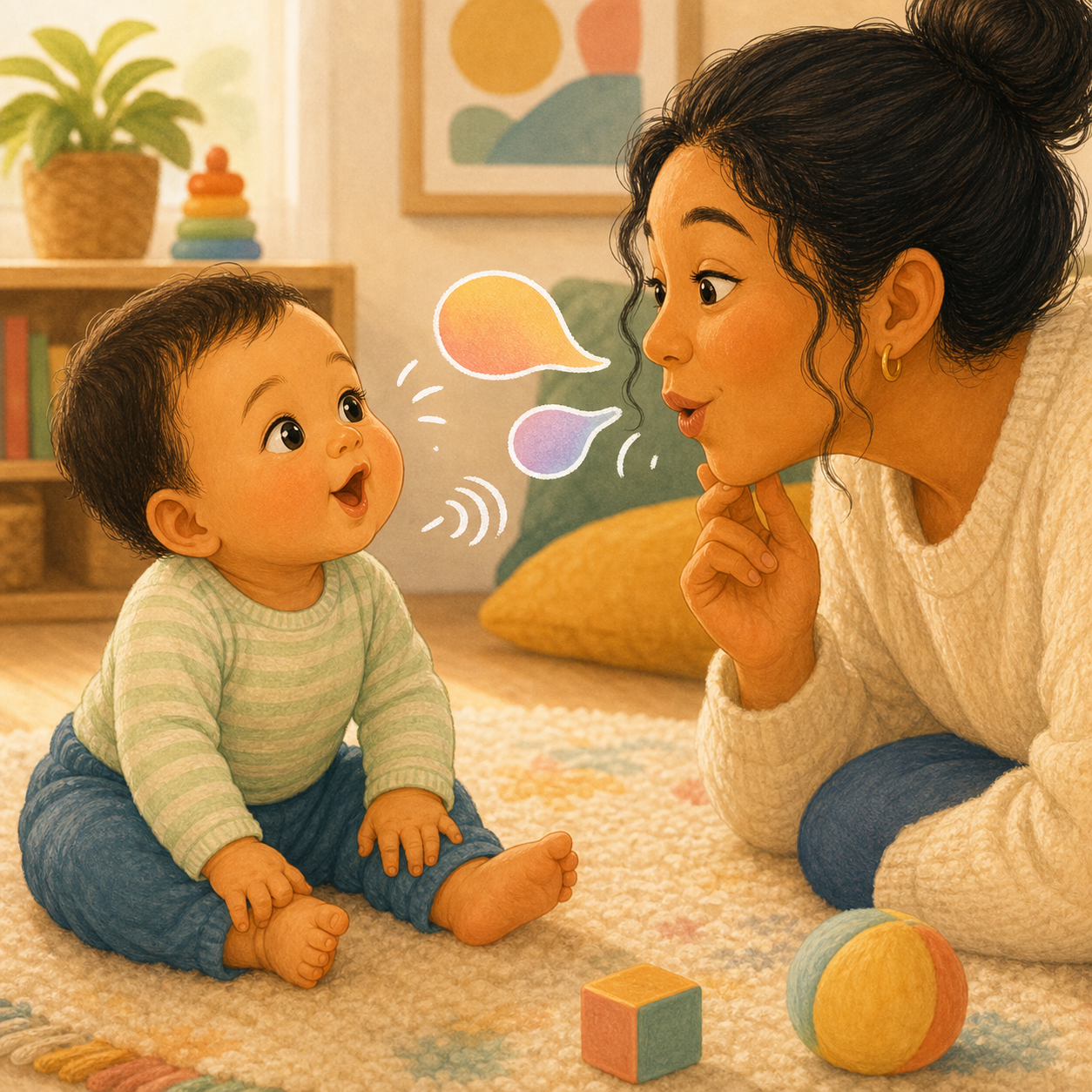
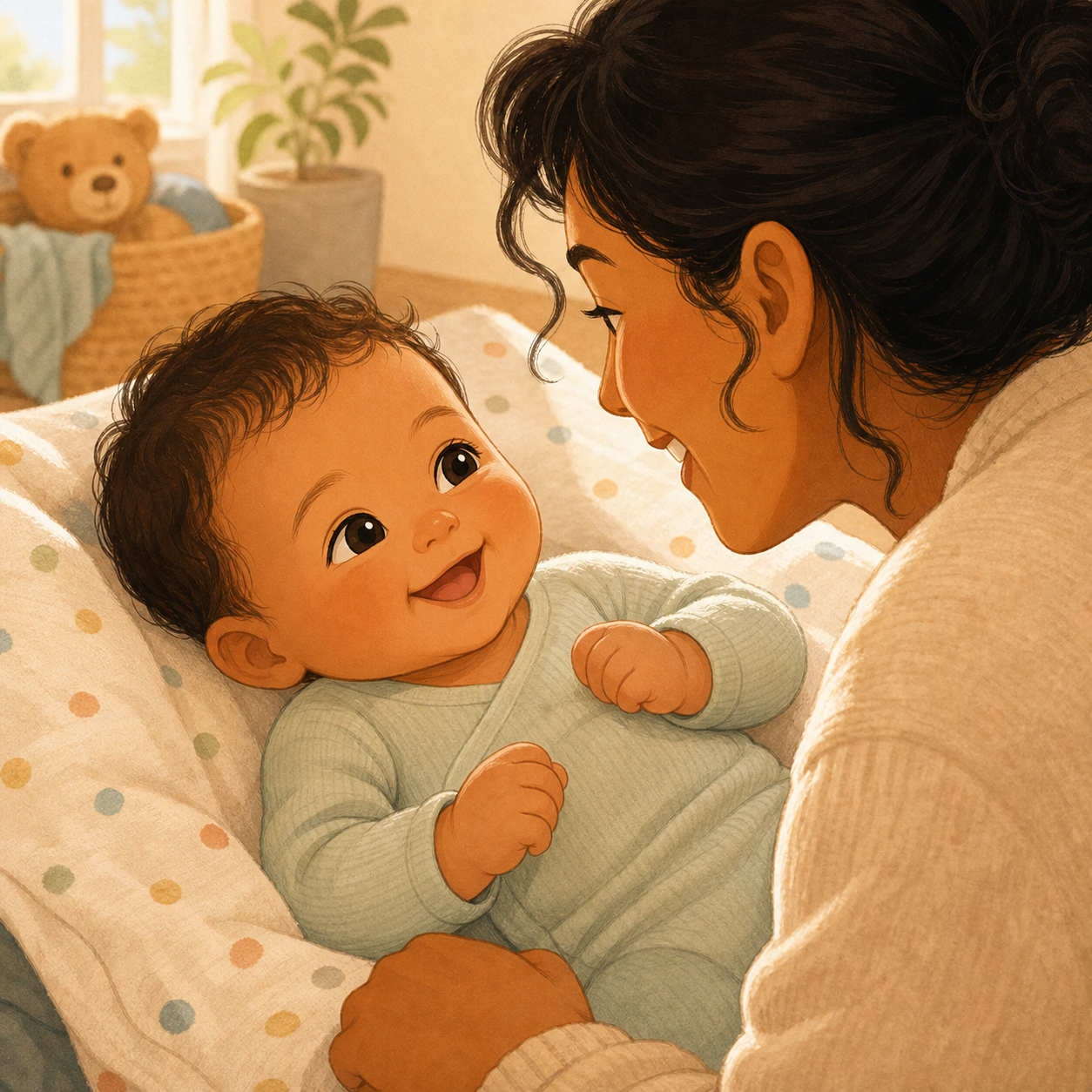
A familiar song gives you something to share: look at your child, sing a short phrase, and leave room for a smile, movement, or sound back. Repeat a favorite line and follow their interest. EchoMom can provide a song and lyrics for that moment; your voice and response make it an interaction. A song you already know works too.
These studies looked at people singing together, not EchoMom. They do not show that an app-generated song will improve sleep, treat a condition, or make a child develop faster.
Read the research and its limits
Feeling closer. In a study of 43 mothers and their infants, a singing session produced a greater increase in mothers' reported emotional closeness than a comparison session involving other interactions. This supports singing as a way to share a close moment; it measured short-term feelings, not a lasting change in attachment. Fancourt and Perkins (2018), Music & Science.
A brighter everyday mood. An exploratory randomized trial with 110 families encouraged parents to sing more often. Parents reported better infant mood after the intervention, including in the following week. The study relied on caregiver reports and did not show an improvement in caregiver mood. Cho et al. (2025), Child Development.
Comfort and attention. In a laboratory study of eight- and ten-month-olds, parents' singing after a brief stressful interaction reduced babies' negative emotions and drew their attention back to the parent. Familiar songs produced the strongest behavioral benefits and more smiling. This supports trying a favorite song when reconnecting; it does not mean singing will settle every upset. Cirelli and Trehub (2020), Developmental Psychology.
A calmer shared moment, or playful engagement. In a study of 30 mother-infant pairs, soothing renditions of the same song lowered measured arousal in both mother and infant (arousal means how activated the body is); playful renditions held the infants' attention more strongly. The finding concerns immediate responses, rather than treatment for stress or proof of better sleep. Cirelli, Jurewicz, and Trehub (2020), Journal of Cognitive Neuroscience.
Early language. Franco and colleagues studied 36 infants at six months and followed up with 26 at fourteen months. More parent-reported singing was associated with better later language outcomes. This was a small observational study, so it cannot establish that singing caused the difference. Observational means the researchers watched existing patterns rather than assigning families to sing more. Franco et al. (2022; online 2021), Journal of Child Language.
Listening to speech rhythms. In a randomized study, nine-month-olds who took part in twelve interactive music sessions showed stronger brain responses to timing changes in music and speech than a play comparison group. This was evidence about speech processing, not a test of vocabulary growth or passive song playback. Zhao and Kuhl (2016), PNAS.
Keep the promise modest. Results vary by setting and outcome. The LongSTEP trial in families with preterm infants did not find improved bonding, and its follow-up did not demonstrate better language development at two years. These studies did not test EchoMom or AI-generated songs. Singing together can be an enjoyable way to connect and explore sounds, without a promise of faster development. LongSTEP bonding study (2023); language follow-up (2024).
When typing is too much
Use your voice to update a care record.
Ask EchoMom to record what happened or find a saved entry. Check the details before relying on a record.
Open EchoMom