Why We Built EchoMom: A Mom, a Dad, and the Long Nights
A hungry baby waiting through five taps. A night shift interrupted by a password reset. A song that still brings back our son's eight-month-old smile. These are some of the moments behind EchoMom.
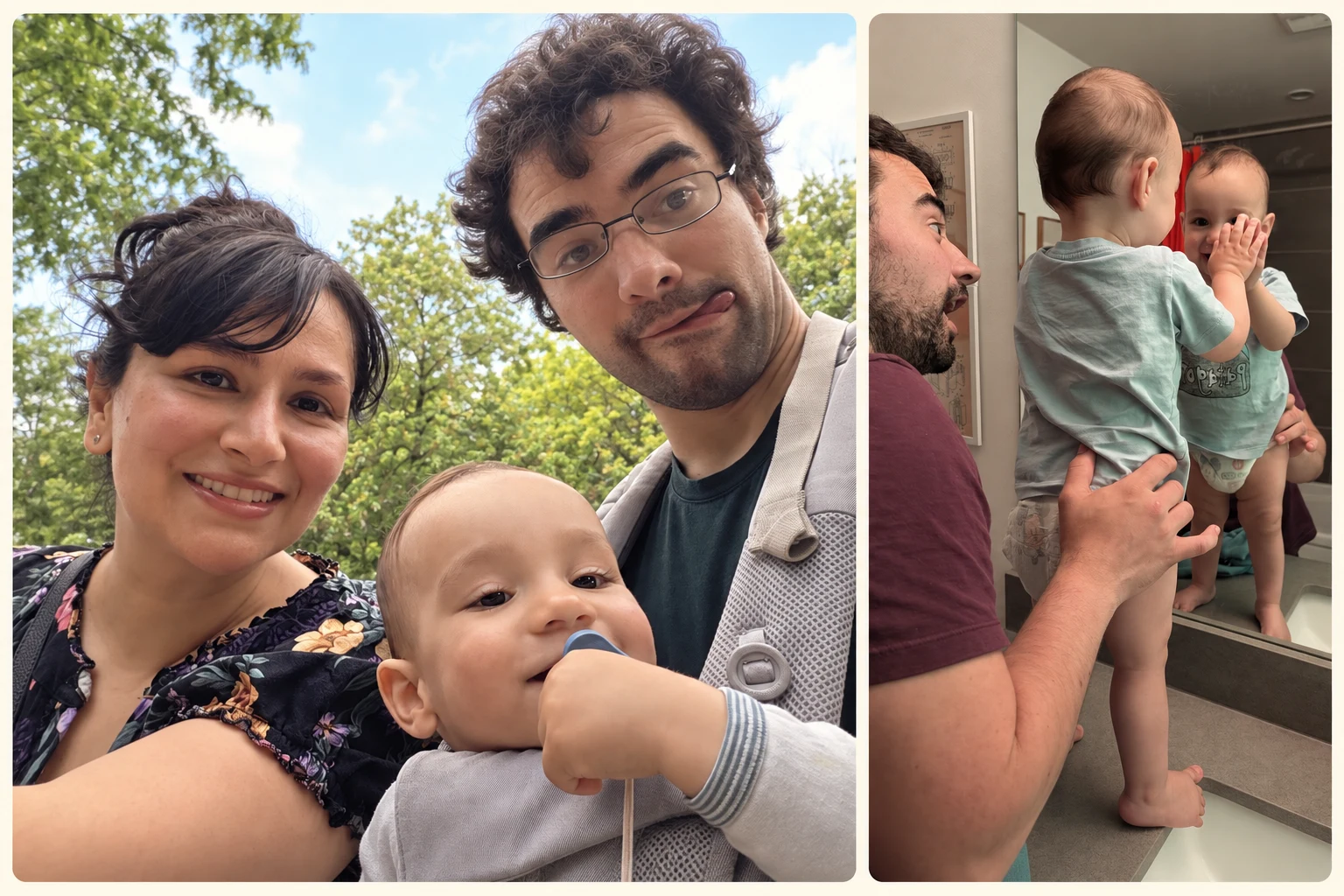
Our family's story, told by Dad
In this story
New word? Find a plain-language explanation in Words in this guide.
Learning to be parents, one long night at a time
When we became parents, we were learning two things at once: how to care for our son, and how to keep going when neither of us had slept enough. There were feeds we were unsure about, nights that blurred together, and little details that suddenly mattered a lot. Which side had he nursed on? What had he eaten? What did the other person need to know before taking over?
I'm writing this as his dad, but EchoMom grew out of life for both of us. My partner was doing the physical work of nursing while also trying to remember and record it. I wanted to take over care with enough information that she could actually rest. We both needed sleep. We both wanted to feel capable. Neither of us needed another complicated thing to learn with a baby waiting.
Our son is about a year and a half old as I write this. We are still figuring things out. The features in EchoMom came from that figuring-out: the parts of the day we found difficult, and the moments we wanted more room to enjoy.
Our son didn't want to wait for five buttons
In a tracker we used, my partner had to work through about five taps just to get to the right place to start recording a nursing session. Our son was hungry. He wanted to nurse, and he got frustrated while she was trying to get the phone ready. Then there was moving around, getting comfortable, and finding the timer again. The small interruptions added up.
That is why the floating nursing timer matters so much to us. On Android, once a session is running and the phone's display-over-other-apps permission is enabled, a small timer can stay above other apps, with controls to switch sides or stop. You do not have to keep navigating back to the nursing screen. On iPhone, the equivalent way to keep an eye on a session is the Lock Screen Live Activity; the floating timer is an Android feature.
A hungry baby should not have to wait for a perfect entry. Feed first and correct the recorded time afterwards if needed. The timer is there to make remembering easier, not to decide when a feed should begin or end.
Recording the breast used also gives you somewhere to note when one side seems different: perhaps nursing there is uncomfortable, or your baby keeps pulling away. A note can help you explain what you noticed to a midwife, lactation professional, or clinician. Timed minutes do not measure milk intake, and the goal is not to make both sides match. If nursing hurts or feeding worries you, get feeding support rather than trying to solve it with the timer.
Sources: NHS: Breast pain and breastfeeding support · CDC: Recognising hunger and fullness
Taking over should mean the other person can rest
A handoff is simply the moment one person takes over caring for the child. That sounds easy until the person handing over is exhausted and the next person needs the last feed, the last sleep, and the thing that was unusual today. We wanted the record to carry some of that remembering, so taking a shift could give the other parent a real break.
Medicines make that especially important. Before giving a dose, check the actual medicine, its strength, the prescribed or label instructions, and what has already been given. Record the medicine, amount, time, and who gave it; confirm those details directly with the other caregiver and agree who is responsible for the next dose. A missing entry is not proof that no medicine was given. An offline phone may not have shared its latest update yet.
EchoMom can help keep that record together. It cannot guarantee that duplicate doses will be prevented or decide a safe dose. If you cannot establish whether a dose was given, get advice from a pharmacist or clinician before giving another. If an extra dose may already have been given, contact your local poison service or urgent medical service immediately; do not wait for symptoms or spend time updating the log first. Call emergency services for severe symptoms.
Sources: Poison Control: Preventing and responding to double doses
A caregiver needs their own way in
We also ran into a much less emotional-sounding problem that became very emotional in the middle of the night: a shared login. After a password reset in a tracker we used, I needed to take over for the night and could not get in. The information existed, but I could not use it when I needed it.
We wanted something that made sense for a babysitter, too. Someone looking after our child needs access to the care information we choose to share, without borrowing our password or relying on one parent's phone. This was our experience with our setup, not a claim that every other tracker works the same way.
In EchoMom, each caregiver uses their own account and is invited to the child's care circle. Permissions control what that person can see and do. Accept the invitation and check access together before the first shift, including the records they will need. Share essential instructions directly as well. The point is to make it possible for another trusted person to take responsibility, while the off-duty parent gets to put the phone down.
Then came the question of what to feed him
Once food became part of the day, we had a new set of questions. What could we offer him? What had he already tried? What had actually been eaten, rather than just put on the plate? Learning about food while keeping up with everything else could feel like another whole job.
The meal estimator grew out of wanting help with that uncertainty. It uses AI to estimate the foods and portions in a photo, and can offer preparation suggestions for you to check. You review and correct the result before adding it to a feeding log. Keeping the types of food recorded gives the next caregiver something useful to look back at, and gives us a clearer starting point when we are thinking about another meal.
There is an important distinction between food offered and food eaten. A photo taken before a meal does not show what your child swallowed. Correct the entry for what actually happened. The estimate is not a nutrition plan, a measured intake, or a check that a meal is free of allergens or choking hazards. Ingredients can be hidden, and AI can be wrong. Check ingredients and preparation yourself, follow your child's care advice, and respond to hunger and fullness rather than trying to reach an app number.
For us, having somewhere to start and somewhere to keep the details is useful. It does not mean we have to turn every meal into a score.
Sources: CDC: Letting hunger and fullness guide feeding
Even a toilet timer has a family story behind it
We have used caregiver-led potty opportunities, sometimes called elimination communication, or EC: noticing a child's signals and offering a supported chance to wee or poo. This does not mean expecting a baby to toilet independently. In our family, we tried sits of around five minutes at first and now closer to three. That experience is why having a toilet timer felt useful to us.
Those numbers describe our experience; they are not a recommended schedule or a target for another child. NHS guidance linked below suggests only a couple of minutes at a time. Keep opportunities brief and comfortable, stay with and safely support your child, and end the sit sooner if they are upset or want to get off. Never leave a child alone on a potty or toilet, or keep them there to finish a countdown. The timer is a reminder for the adult, not a demand on the child.
Sources: NHS Just One Norfolk: Toileting at your child's pace
As his dad, I wanted to build our bond from the beginning
I wanted ways to be close to our son through all of this: taking a turn caring for him, talking to him, playing, and singing together. I wanted those ordinary moments of connection to belong to me and him, too.
Research on fathers looks at bonds from early infancy. In a 2021 study, fathers reported on their bond when their babies were two to four months old. That does not set a deadline for another dad, or tell us the average age when fathers bond. It did not test EchoMom, either. For me, the reason to sing and share everyday care is simpler: I want to know my son, and I want him to know me.
If closeness is taking time, you do not have to perform a particular feeling for anyone. Talking, cuddling while awake, responding, and sharing everyday care offer opportunities to get to know your baby. If you are worried about bonding or how you are feeling, speak with your healthcare professional. There is room for support as well as love.
Sources: Gettler and colleagues, 2021: Fathers and early infant bonding · Berkshire Healthcare NHS: Bonding with your new baby
Why there are songs in a care app
Some of my strongest memories are of our son at eight months old, screaming, and a song changing the moment. Something that had been hard suddenly became fun. There was our little boy's joy and excitement, and there we were getting to share it with him.
He is a year and a half old now, but playing one of those songs brings that younger version of him right back to me. A song made just for him carries something personal. I hear it and remember his face. Each time we sing and play together, I feel like I am keeping another piece of this age in my memory.
That is why songs belong in EchoMom for us. They are for our child, and they are for us as parents. The log can tell us when a feed happened. A familiar song can bring back what being with him felt like.
During playtime, music also gives us a way to turn practising a new skill into a game. A milestone means a skill a child develops, like a new movement or sound. We can celebrate an attempt and enjoy ourselves without making every activity feel like work. There is no promise that a song makes a child reach a milestone sooner.
There is some research behind the simple pleasure of singing together: in a 2020 study of eight- and ten-month-old babies, parents singing after a brief stressful interaction reduced distress, with familiar songs drawing more smiles. That was a short laboratory study of parent singing, not a test of personalised recordings or EchoMom. A song will not settle every cry; we still need to respond to hunger, discomfort, illness, and the need for closeness.
You do not need a generated song, a subscription, or a good singing voice to have that moment. A song you already love can become yours together. For our family, making songs especially for him has been one way of holding onto it.
Sources: Cirelli and Trehub, 2020: Familiar songs reduce infant distress
Made by a mom and a dad who are still learning
EchoMom grew from both sides of parenting in our home: a mom trying to nurse without fighting with a phone, a dad trying to take over a night, and two people who wanted to remember more of their son's joy. We built the things we wished we had within reach, and we hope they are useful to other moms, dads, and caregivers too.
Our family is only one family. You may feed differently, share care differently, or never use a potty timer. Take the parts that help. You do not need a complete log or every feature switched on to be a caring parent.
If you are in those first long nights now, learning your baby while learning everything else, that is who we had in mind. We hope EchoMom can help you hand over a little of the remembering, get a little more room to rest, and be there for the moments you will want to carry with you.
Care basics and sources
For every sleep, place babies on their backs on a firm, flat, level sleep surface designed for infants, without pillows, loose bedding, or soft toys. Share a room rather than a bed. An app timer cannot check that a sleeping baby is safe. NICHD: Safe Sleep Environment.
Notice your baby's hunger and fullness signs. A baby does not need to finish a bottle to match an amount in the app. Follow the feeding advice given for your child. CDC: Signs Your Child Is Hungry or Full.
Words in this guide
Hover over an underlined word, tap it, or use the Tab key for an explanation. Press Escape or tap outside to close it.
- elimination communication
- An adult notices a child's signals and offers a supported chance to wee or poo. It does not mean a baby can toilet independently. Keep opportunities brief and comfortable, stay with the child, and stop if they want to get off.
- allergen
- A substance that can trigger an allergic reaction in someone allergic to it. A food containing an allergen does not mean every child is allergic to that food.
- nursing
- Breastfeeding. EchoMom's nursing timer records time and breast used; it does not measure milk intake.
- milestone
- A skill a child develops, such as smiling, speaking, or walking. An app observation is not a developmental test.
- permission
- What someone or something is allowed to do. Caregiver permissions control access to a child's information; phone permissions allow features such as the microphone or notifications.
- AI assistant
- Artificial intelligence: software that responds to what you say or type. It can make mistakes and is not a healthcare professional.
- offline
- Without an internet connection. A change saved on your phone may need a connection before another caregiver can see it.
- Live Activity
- An iPhone feature that keeps an ongoing update, such as a nursing timer, visible on the Lock Screen.
- Floating nursing timer
- An optional small breastfeeding timer that stays visible above other apps on Android.
- handoff
- When one person takes over caring for the child from another. Sharing recent feeds, sleeps, and other records helps them know what happened.
When typing is too much
Use your voice to update a care record.
Ask EchoMom to record what happened or find a saved entry. Check the details before relying on a record.
Open EchoMom